
Some men only know how to hand love across sideways.
My great-grandad believed profanity was somewhere between punctuation and a sigh.
“Fuck me a runnin’,” he’d mutter softly, like a man saying grace over catastrophe. Given the shape of most days, it was hard to argue with him.
He wasn’t a philosopher. He was a worn-out Appalachian man who lived under pipe smoke, drank too much, and carried enough meanness in his younger years to leave marks that lasted longer than bruises. He never learned how to live gently with the people closest to him. To my knowledge, I never saw him scared, though I suspect now that’s because fear had long ago changed shape inside him and settled into habits no one questioned anymore.
What stayed was the language.
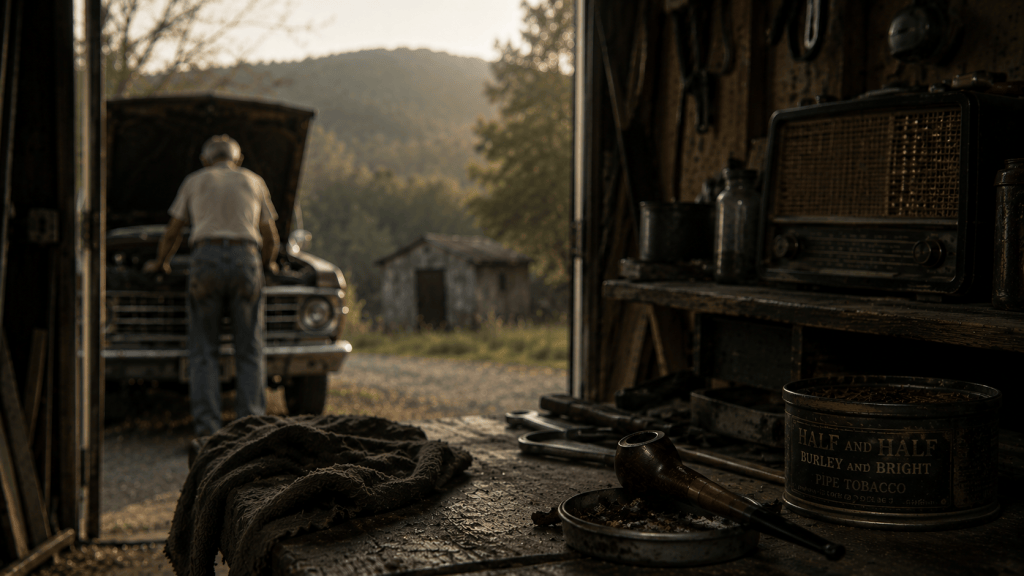
Not speeches. Not wisdom. Just sayings. Phrases tossed into the air while fixing a mower, hauling lumber, or standing in the garage tamping tobacco into his pipe while Marty Brennaman drifted across the radio in the background.
If I was fumbling a task, he’d shake his head and tell me I looked like “a monkey trying to fuck a football.” He wouldn’t even look up from whatever rusted thing he was trying to force back into usefulness.
If some plan of mine was doomed from the start, “that dog won’t hunt.” He’d wipe grease on his worn-out jeans, spit, and turn back to whatever work had more promise than my latest idea.
If I got angry and started puffing up like boys do, he’d grin and tell me I “couldn’t beat a soapy pecker.” Let me tell you, there’s no dignified way to keep posturing after that.
But the one I remember most was quieter. Whenever I hurt myself working with him, he’d look over almost reflexively and say, “Don’t do that, it hurts.” He never asked if I was okay. That was about as close as he came.
These sayings didn’t sound like wisdom then. They sure as hell haven’t ripened into wisdom now, but they do carry something. They belonged to an emotional language built sideways by people who held emotional language with suspicion.
Nobody said they were overwhelmed. They were stove up. Nobody announced vulnerability. Nobody sat down to process. Feelings leaked out disguised as livestock, machinery, weather, profanity, and bodily injury. Concern arrived having not shaved for three days so nobody would confuse it for soft.
As a kid, I barely noticed the wording. As a man, I can hear the machinery under it.
There is no use polishing him now.
He hurt people. Some of them badly. He was difficult. Sometimes cruel. Whatever softness age brought him, it did not turn him into some wise old mountain saint on a porch swing somewhere above the clouds. Appalachia produces enough mythology without my help.
But I think now those sayings mattered because they were traces, the residue of a man who lacked cleaner tools for contact but reached anyway.
I still catch myself saying some of those phrases now. They rise out of me unbidden, like water finding the worn path down the mountain. I’ll mutter one under my breath while carrying groceries or fixing something in poor light and suddenly he’s there again: pipe smoke, Half & Half tobacco, rough hands, exhausted eyes, and Marty Brennaman somewhere in the distance, narrating another long summer evening.
Looking back, I think pretending was important to him. Especially pretending feelings were things that mostly happened to other people.


2 responses to “Don’t Do That, It Hurts”
Another gorgeous piece of writing. We have tendencies to color our backgrounds/pasts in shades of honesty or truths as we feel them.
You’ve made this look back heartwarming and poignant yet included all of gritty and grimy even so. And it never felt like that once. I have a new compassion for grandad. Surprisingly so.
Great work ❤️
LikeLiked by 1 person
I am glad some of the complexity came through. It’s tempting to sand people down with nostalgia or flatten them into their worst moments. I was trying not to do that here. I’m always so appreciative of the attention you give to what I write. Thank you.
LikeLiked by 1 person