
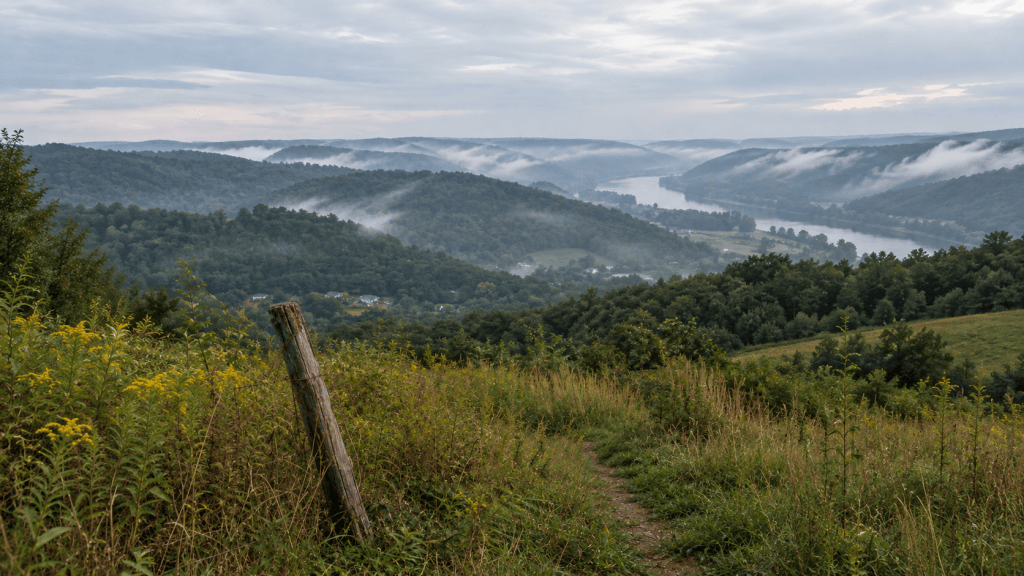
There’s a spot in the world where the boot of Ohio presses into the soft underbelly of West Virginia. A place where the Ohio River makes its way west and, having never met the Mississippi, still thinks itself mighty. So much so, in fact, that every so often it tries to wipe the people and businesses along its shores off the map.
I can’t say it’s a singular place. There are probably a million places that wear roughly the same uniform with a slightly different fit. It is my place, though, and my people’s place. Dominated by the river and weirdly compressed between its shores and the hills and sandstone cliffs of the valley. Towns center on hollows and ridges. Geography dictated where people built their lives and into which hillsides they dug to construct their homes. The old roads in and out are torturously curved because they followed the little creeks that had already cut their way through the hills.
Somewhere between the shores of that river and the foothills of the Appalachian Mountains, I was born.
Grew there. Played there. Laughed there. Was hurt there. Fell in love there. Worked hard to escape from there.
I ended up finding my way back.
In childhood, it was my universe. Like a fish in a pond, I swam along without even knowing I was in water. There came a point, though, when the boundaries of the river and hills, the hollows and high walls, the culture and people themselves made me claustrophobic. I had to escape.
Looking back, I had my reasons. There was limited opportunity. There was poverty. Small-town scrutiny. Backward ways that I had no interest in defending then and still don’t feel obligated to defend now. Everybody seemed to know everybody else’s business, and half the time they knew it wrong. The world felt bounded by the ridge line, and I was convinced there had to be something larger waiting on the other side.
I didn’t want to be one of these people.
There is something embarrassing in admitting that now, but embarrassment doesn’t make it less true.
Sitting here decades later, I have some thoughts about that cock-sure and naive young man. Too dumb to understand the size of what he couldn’t imagine. Carried forward by the false confidence of a plan into a future he assumed would cooperate, with no clue about the joys, sorrows, wounds, and scars he would face.
I suppose I should thank him. He wasn’t wrong. I had to leave to become who I am.
I do wish he would have exercised a little more, though. Maybe learned another language. Invested in Apple stock. Made a few different choices.
I’ve traveled a lot of miles since those days of skipping rocks on the Ohio and picking my way along sandstone cliffs. A university became my ticket out. I joined the military. Became an officer. Became a physician. Traveled the world. Became a father. Went to war. Loved some people. Lost some things. Hurt people. Was hurt by some.
In short, I found myself in places and rooms that dirty little hillbilly kid never imagined.
I escaped.
Or at least I thought I did.
You don’t notice certain things while you are living inside them. You don’t notice an accent until someone hears it. You don’t notice a family habit until someone else’s family doesn’t do it. You don’t notice what your people consider normal until you move somewhere that doesn’t. By the time I began noticing, many of those assumptions had already hardened into habit.
I carried with me the idea that being useful matters. That work should produce something visible. That food was one way people care for one another. That a man ought to be able to do for himself what needs done. That a man can express love by his willingness to move something heavy. That money disappearing still has a bodily meaning even when you have enough. That humor belongs near suffering. That people may tell you almost nothing about what hurts and still want you to notice anyway. That emotions can be handed to you sideways. And that you don’t throw away something merely because it has become troublesome.
You fix it. Then you fix it again. You wrap wire around something that shouldn’t require wire. You replace a part whose name you may or may not know. You keep an old lawn mower going seven summers longer than it has any reasonable right to survive, partly because a new one costs money and partly because the bastard started last year, and I’ll be damned if it won’t start this one.
A lot of love where I came from arrived without announcing itself.
Someone showed up with a truck. Someone fixed the thing that had been broken for three months. Someone sent you home with food in a Tupperware bowl you were absolutely expected to return. My great-grandmother’s little brother, Arty, would spend hours picking quarts of blackberries and give them to my grandmother for the price of a slice of pie. A man who might never tell his son he was proud of him would spend half a Saturday underneath the boy’s car because the brakes were making a noise. People brought chainsaws after storms. They climbed onto roofs. They stood beside hospital beds and at funerals and rarely had much useful to say.
They just stayed.
There was tenderness in that. There was limitation too.
If love is always handed sideways, sometimes the person receiving it never quite knows what was being offered. If pain is only acknowledged by continuing to work, sometimes work becomes a good place to hide. If being useful becomes too closely tied to worth, eventually rest starts feeling suspicious. And self-reliance, admirable in reasonable doses, can turn into the strange conviction that needing another person is a kind of personal failure.
I have carried some of that farther than I should have. There have been times when I have known exactly how to carry someone else’s load and had no idea how to let anyone touch mine.
That is inheritance too. Not wisdom. Not pathology. Just an old tool that works until it doesn’t.
The people I grew up around were not mountain saints. Hardship did not refine everyone. Some people got kinder. Some got harder. Some drank. Some left. Some stayed and resented everyone who did not. Some broke things they loved. Some repaired things that should probably have been thrown away.
Mostly, they were people doing what people do everywhere, only doing it within the particular boundaries of that river valley, with its hills and churches and garages and kitchens and rusted tools and habits of speech.
I have read and written for most of my life, but there came a point when the weather changed and the writing became more serious. I didn’t set out to write about Appalachia. It didn’t even occur to me to. I was writing about grief. Memory. Love. Loss. Duty. Restraint. Endurance. All the old words and ancient human material.
Then eventually I noticed something.
Damnit, I keep writing about ground.
Ground that in my mind was covered in oaks, maples, and poplars. Ground that rose into hills and dropped into hollows. Fence lines and fields. Creeks cutting their way toward the river. Houses cut into hillsides. Kitchens lit dimly over old stoves. Garages full of tools kept long after anyone remembered why. The hands, work, sayings, and silences of old relatives and people I grew up around.
The language kept returning there because apparently some part of me had never left.
I didn’t decide to write Appalachian literature. I realized that I had spent much of my youth trying to leave Appalachia before I understood how completely I had already absorbed it.
Appalachia had apparently decided what vocabulary I had.
Most mornings now, I still find myself driving along the Ohio. I drive my son to school and listen to his plans to escape. I hear the echoes of that cock-sure, naive young man. I wonder what my boy will face. I wonder how many of the habits of home he’ll carry with him. I wonder if he’ll find himself back here too.
The river lies low beside the road, brown or golden depending on the light. The hills rise close on the other side, leaving the road nowhere to go except along the narrow strip between them. Houses sit above me where someone found enough flat ground to build one. Fog settles into the hollows. Sometimes the river rises.
None of it looks particularly profound. The hills do not teach lessons. The river does not care who stayed or who left. People are still getting up, going to work, fixing what they can, carrying what they have to.
That damn lawn mower still coughs its way into life when it’s asked to.
I used to look at those hills and see the edge of the world.
Now I mostly just see home.


4 responses to “Mostly Home”
Hello! Good to see you again. Beautiful piece. Where you were raised sounds absolutely amazing! I can see where you would want to leave and grow. I think many of us (dare I say all) feel the need to breakout and fly. Many people in my town have burst out of my town’s bubble. Many of them return. I am one of them. It called to me and I listened. As much as I am now looking to relocate when I retire, I don’t know that I can.
Thank you for this! Hope all is going well.
LikeLiked by 1 person
Yes, the escape and return having learned something you weren’t expecting is an old one – hero’s journey archetype kind of ancient.
Im not sure my place in the world is amazing, at least not singularly so. It has its raw places and its limits. It’s mine though.
Yes, I’ve not posted much in quite a while. I was consumed by the final bits and pieces for the book I published. Now that that is complete and I’ve recovered from editors exhaustion I hope to write more again.
Thanks for reading and commenting. I appreciate it.
LikeLiked by 1 person
Congratulations on your book! How exciting! Keep us posted on that journey. I’m sure we will all check it out!
LikeLiked by 1 person
I guess my post about the book was a little obscure. The details of the book can be found here: Held Ground
LikeLiked by 1 person