
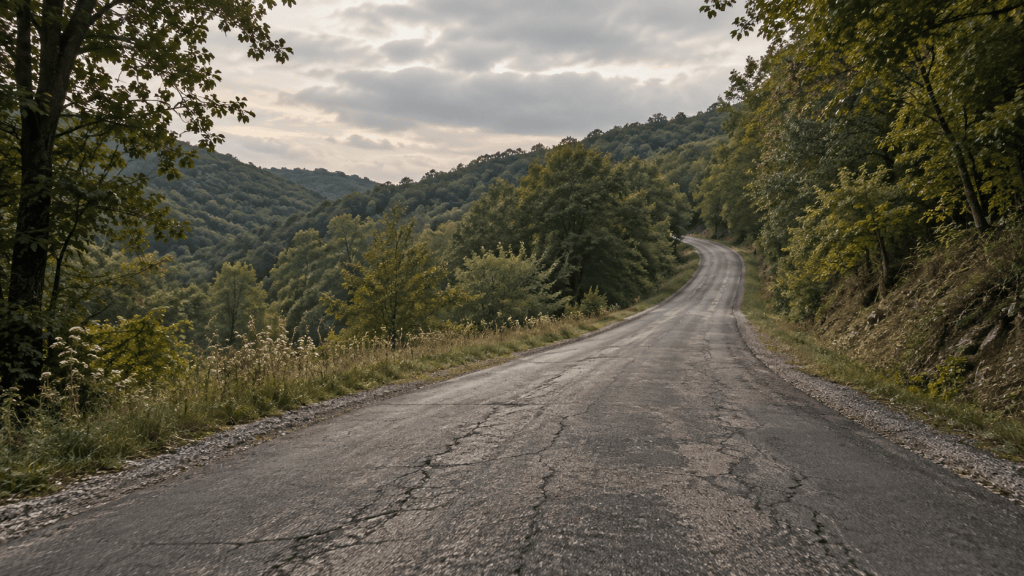
Running eventually becomes an argument my body has with my mind.
At first the body is cooperative. Breath settles. Legs find their rhythm. The road moves underneath without requiring much negotiation. Then something changes. Heat. A hill. A bad mile. The ordinary accumulation of distance. The body begins making its case.
Slow down. Walk. Turn around here. You’ve done enough.
Sometimes it is right. That is the irritating part. My body is not an enemy. Pain occasionally carries useful information, and I have lived long enough to know stubborn men can injure themselves proving points no one asked them to make. I’ve also lived long enough to know those injuries sometimes prove little more than how old and mule-stubborn I am.
But sometimes nothing is injured. It just hurts. And hurt has a remarkably persuasive voice.
Sometimes I run because I want to finish. Sometimes I run because I know most reasonable people would stop. Sometimes I run because my body told me to stop and I didn’t like its tone or its implications. There are few things more ridiculous than a grown man taking a physiological warning as a personal challenge, but apparently I remain available for the assignment.
There is nothing noble about that last one. There is no meaningful victory waiting at the end of the road. No one cares whether I run another mile. There are no crowds. No medals. At best, my Garmin notices, and Garmin has never once seemed impressed. Half the time there is barely enough dignity left to call what I am doing running.
Still, some part of me answers: No. You do not get to take this mile too.
Most stories about perseverance assume there is something worth reaching. A finish line. A home. A marriage. A future self. A life being built toward some recognizable end. Those become our whys. The old proposition is that a strong enough why can make almost any how tolerable.
My divorce changed that math for me.
I had lived inside a future that felt durable. Not guaranteed by some childish arithmetic, but solid enough to organize a life around. There was a home, a marriage, a family, a set of plans extending forward. Then the world shifted.
It wasn’t that the destination became difficult to reach. I understand difficult. Hell, I thrive on difficult. I would have buckled down, dug in, worked harder, found another path. Difficulty still assumes there is somewhere to get.
There wasn’t.
The destination had disappeared while I was still walking toward it. The road didn’t get harder. Somebody took away where it was going.
That does something peculiar to perseverance. It had always seemed reasonable to endure a difficult road when the road led somewhere worth going. Take the hard assignment. Spend the years in school. Deploy. Run the extra mile. Do the work. Accept the cost now because something on the other side gives the cost shape.
But once a place you had organized your life around can simply cease to exist, without any say so on your part, destination becomes a less reliable argument.
The world can be one way and then not. A home can stop being home. A marriage can stop being a marriage. A future spoken about often enough to feel almost remembered can disappear without accounting for how much of your life you had already spent building toward it. Reality does not refund sunk cost.
That doesn’t make goals foolish. I still make them. I still plan. I still want things badly enough to work for them. I just stopped pretending reality owes me compliance because I did the work.
Once destination stopped being enough reason to continue, continuation had to become a decision I could make without guarantees.
We like to dress perseverance in a clean uniform and give it respectable names: courage, faith, discipline, purpose, resilience, hope. I have known those to be true sometimes. But sometimes a person continues because stopping feels too much like surrender. Because enough has already been lost without volunteering anything else. Because some primitive part of him simply says no: you do not get this too. I am not stopping here simply because stopping would be easier. And you sure as hell do not get to decide what I do next.
There were days after my marriage ended when hope simply wasn’t doing any useful work, and I eventually grew tired of pretending otherwise. I did not wake believing everything would work out. I did not sense some larger plan bending the wreckage toward good. There was no warm conviction that suffering was whittling me into the man I was supposed to become.
Some mornings I was simply pissed off that life had apparently mistaken me for something that was easy to kill.
That turned out to be enough.
Not enough to repair anything. Not enough to make the loss meaningful.
Enough to get dressed. Enough to work. Enough to answer my sons. Enough to write. Enough to lace up my shoes and put one foot in front of the other when some part of me would have preferred to stay still. Some days survival was not noble enough to deserve the word resilience. It was just refusal to quit before bedtime. There is an undignified kind of strength in saying no after all the noble language has packed up and gone home.
No, you don’t get my work too. You don’t get my sons. You don’t get the miles I can still run or the things I haven’t written yet. You don’t get every future morning simply because you ruined some of them.
Take what you already took.
The rest is still mine.
I know spite is poor fuel. It burns dirty and leaves residue everywhere. You would not want to heat a house with it for forty years. But when you are stranded somewhere cold, you stop being particular about what catches fire.
There are runs I should stop. Roads I should turn from. Things a man can destroy by insisting that endurance itself makes him virtuous.
But sometimes nothing is broken. It just hurts.
And I keep running.

