
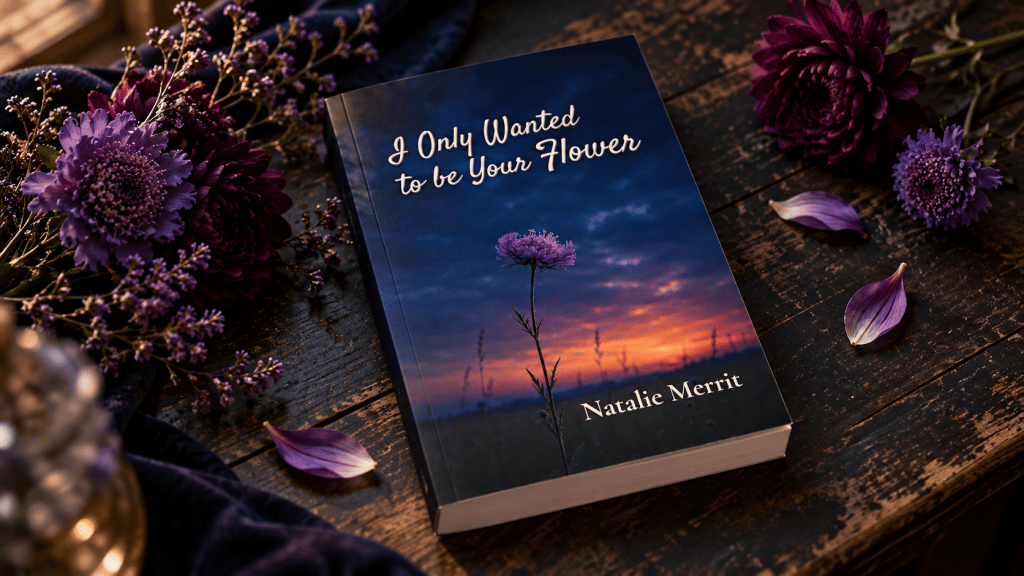
“Peony” closes Natalie Merrit’s (@erroneouschoices) book of poetry I Only Wanted to Be Your Flower. Held Ground Press, which I run, is the book’s publisher. I love this collection, and this poem holds much of what I want to share about it.
Peony
Natalie Merrit (@erroneouschoices)
The best thoughts are the ones that no matter how many
   times you bury them or burn them
they always end up in your ink or on your tongue.
I make so many moods in silence, with a vast expanse of
   light bending moments
that I’ve put everything I didn’t say in a mixed tape for
   you. I'm sick and my fever tastes like you. Or like you
   and me. Or like paper cuts, I can’t remember. I’m full
   of all the unspoken questions that only touch may
   answer.


Be wary, I’ve never needed the sun to bloom. I’m always
    where your mouth should be, pick
up my petals baby, and shove them all down your throat.
    Trace your name along the curve
of our afterglow, stitch your blue palette heart into my
    delicate things.


The moon is so tenderly shadowed and it’s harvest but
   I’m so far behind. Each of my pulpy
seeds is a whisper and a secret unfolding through my
   fingertips ready to take root in the
grave dirt and foxglove dew.
I watch everyone rush by me and I’m never enough, or
   right, or enough. Still, I’m everyone’s
bone-ache and I cradle their voids and caress their
   gentleness. I’m swallowing pill after pill of spoil and
   discernment, I’ve become your short-term memory
   and my own broken
From I Only Wanted to Be Your Flower. © 2026 Natalie Merrit.
“Be wary, I’ve never needed the sun to bloom.”
There is a great deal of force in that sentence. The speaker knows something about her own capacity to grow. And yet the poem around it is full of wanting: a mouth, a touch, a place in another person’s memory. That knowledge has not made longing disappear. Both are present, and neither politely steps aside for the other.
The tenderness here has teeth. Petals are delicate things, but the speaker has very definite ideas about what should happen to them. I want to leave some room around that image. Part of the pleasure of reading Merrit is feeling how quickly a familiar word becomes strange in her hands. A flower can carry desire, anger, care, and the possibility of growing again, sometimes within the same breath.
There is also the quieter admission near the end: everyone rushing past, the feeling of never being enough, the work of cradling other people’s emptiness. That sits beside the earlier declaration of independence. I find that proximity convincing. Knowing our strength and feeling it are different experiences. We can recognize what is alive in us while still wanting someone else to recognize it too.
The collection moves through Hunger, Devotion, Rupture, and Becoming. Longing runs through all four. Early on, another person’s attention can seem to make the speaker more visible to herself. Devotion deepens that attachment until love, refuge, and identity become difficult to separate. When it breaks, the poems keep the bodily knowledge of what has been lost. The mouths, bones, flowers, and ink remain, carrying different weight as the book moves forward.
Becoming is the part of that movement I especially love. Desire continues. So do doubt, tenderness, anger, and the need to speak. In “Black Ink,” near the end, writing changes the speaker, and she begins to carry what she once buried. “Peony” follows with its own mingling of defiance and need. There is growth here, and there is still pain. The book allows both to remain visible. It trusts us to stay with someone who is still becoming.
The book is remarkable and is available for purchase on Amazon.


2 responses to “I’ve Never Needed the Sun to Bloom”
Yes, she is an insightful talent.
LikeLiked by 1 person
That she is. Thanks for reading.
LikeLike