
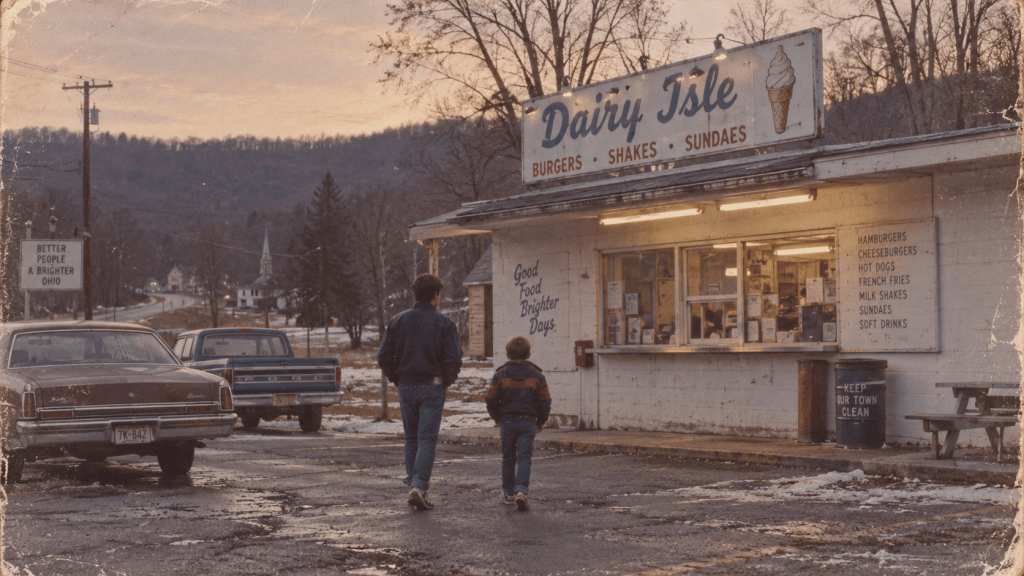
Hamburger. Ketchup only. Small fries.
That was my baby brother’s order.
There was a stretch when I was fourteen and he was eight that we spent nearly every day together. The teachers in our school system were on strike. Our parents still had to work, and he and our middle brother fought too much to be left together, so he was handed off to me.
I don’t remember anyone making much ceremony of it. I was the oldest. He was the youngest boy. Somebody had to keep an eye on him.
Most days we managed to scrounge together enough money for lunch at the Dairy Isle. We would walk in and order the same thing. Mine has disappeared from my memory. His hasn’t.
Hamburger. Ketchup only. Small fries.
He was as stubborn as he could be sweet. His words could bring equal pain and laughter depending on his weather. He dreamed bigger than his body. Trouble seemed to find him, although even then I suspected he went looking for some of it just to make a point. He bristled at authority in ways I never would have dared. He loved basketball and hated being coached. There was something in him that resisted being told what to do, even when what he was being told made perfectly good sense. It often felt like spite was his only motivator, then he’d grin and make you question yourself.
I envied some of that.
I was the anxious one. Grades mattered too much. Good behavior mattered. Performance mattered. I wanted adults to approve of me, and I spent a fair amount of energy making sure they did. My little brother seemed largely untroubled by any of that. If he disappointed somebody, he appeared confident they would recover.
He had hair the color of bleached corn silk, and a cowlick that split it into an exaggerated part no amount of combing could quite correct. I can still see it when I picture him at eight.
That fall and winter, we wandered around town together waiting for school to begin again. Had snowball fights. Ate cheap hamburgers. We argued—no—I argued at him. I told him what to do and he mostly ignored me. I was old enough to feel responsible for him and young enough that responsibility still felt uncomplicated.
He was my little brother.
That seemed explanation enough.
Years later, he found himself in Texas. By then he had burned most of the bridges available to burn. He had nowhere useful to go and no good way to get there. He needed someone to come get him.
My wife thought going after him was a mistake. She was probably right. She cared about him, but it was not her little brother. She could look at the situation and see what was plainly there: he had already exhausted most of the chances available to him back home, and bringing him back did not make those facts disappear.
I knew that too. I went anyway.
It was roughly twelve hundred miles, and I made the drive in about twenty hours. I picked up my little brother, turned around, and brought him home to live with me. I knew I was biting off more than I could chew. Knowing did not seem to have much influence on the decision.
On the drive back, I lectured him. I told him what this was going to require. No drugs. No chaos. No taking advantage. I had a wife and a child, and whatever happened between him and me could not be allowed to spill over onto them. I tried reason. I tried authority. I tried guilt. I reminded him what I was doing for him and what it was costing.
He promised he understood.
He still dreamed big. There was always a plan somewhere just over the ridge line, something he was going to do, somewhere he was going to get, a version of his life that remained available if everyone could just give him enough room and the right tools to reach it. Somewhere during that long drive, between the lectures and promises, we laughed too. We laughed a lot.
He could still make me laugh harder than almost anyone. He would grin after saying something aggravating enough to make me want to pull the car over, and for a moment I could see him exactly as he had been—the little blond boy with the cowlick, the kid who hated being coached, the one who ordered a hamburger with ketchup only and small fries.
That boy was never very far away from me.
So when we got home, I gave him time to get settled. I gave him money. I let him use my car. I gave him enough trust to break every promise he had made.
Christmas was when I found out. My debit card was declined.
There are moments when understanding arrives before you are willing to put a name to it. I stared at the machine, already knowing what I didn’t want to know. He had been stealing from me.
Again.
I remember the anger. I remember the humiliation of having allowed it. Mostly I remember the certainty with which I told myself: never again.
I meant it.
Never again happened again.
He was better. Or doing better. Or trying. Or he just needed a chance. There was always a sentence available that made one more chance sound reasonable.
Sometimes he needed forty dollars. Then another forty. Nothing large enough to feel like catastrophe. Small amounts were easier to explain. Sometimes I paid him to do odd jobs, usually more than the work was worth. Sometimes he finished them. Sometimes he did not. Calling it work made the money easier to hand over. He was not asking me for money. I was paying him. That distinction became useful.
Then things would disappear. A tool I knew I had put somewhere. A pile of change I had been saving until it amounted to something. Something small enough that certainty required effort.
Maybe I misplaced it. Maybe my wife moved it. Maybe I had used it and forgotten.
I did not want to look too closely because looking meant I might find it, and finding it meant I would have to do something.
“Can I borrow” developed its own meaning between us. Can I borrow forty dollars? Can I borrow the car? Can I borrow this? Borrow usually meant have, and eventually I learned that the ask itself often meant something else. He was using again.
I began changing the way I saw a room when he walked into it. I noticed what could be taken, what was easy to carry, what had value, what I should probably move before he noticed it. I told myself I was removing temptation, protecting him from himself, making things easier for everybody. Mostly I was learning how to have my little brother in my house without trusting him in it.
It changed how I sat with him too. We could be talking about nothing important—the Bengals, the Buckeyes, someone we both knew—and some part of my body would still be waiting. I would lean forward slightly. My stomach would tighten. I listened for the ask, then the explanation, then the plan, then the promise that things were different now.
Eventually I could feel myself scanning for trouble before he had done anything at all. I hated that. I hated what he had done, and I hated what I had allowed. I hated that my body had learned to prepare for him.
The cowlick was still there, the same ridiculous part in his hair I had known when he was eight. By then, my body had learned to read it differently.
Eventually the question was no longer whether I loved him. That part was easy. The harder question was what that love authorized me to do, and what it required me to permit.
I had spent years treating “he’s my brother” as if it settled the argument. It didn’t. I was also a husband and a father. My wife and child did not become less family because his claim on me was older. Every time I brought his chaos back through the door, I was making a decision for them too. I had promised on that long drive from Texas that whatever happened between him and me would not spill over onto them. Then I spent years trying to manage the spill.
There was no clean point where helping became participation. Sometimes I said no and wondered whether I had abandoned him. Sometimes I said yes while already knowing I would regret it. Understanding what drugs were doing to him made the line harder to see, not easier. It could explain the lying, the appetite, the relentless narrowing of his world toward whatever would bring relief. Explanation did not put the money back into my account. It did not return a missing tool or make my wife feel safe leaving her purse in the room.
For a long time I kept assuming there must be some correct amount of help. Enough to keep him standing without holding him up. Enough consequence to matter without letting him fall too far. Enough love to make a difference without allowing that love to be used against me. I never found it. There was no gauge that turned red. Mostly there were decisions made one at a time, each with incomplete information, followed by the knowledge that I would have to live with whatever came next.
Blood is strange that way. It can make another person’s ruin feel partly like your responsibility. Their phone rings and something old in you answers before judgment has time to put on its boots. You go. You carry. You forgive what you swore you would not forgive again. Not because they earned it. Not even because you want to. You do it because their face was at the table before you knew what a table was.
But blood is not absolution. It does not make cruelty holy or turn endurance into love. There were things I eventually had to refuse. I found a way to do it by getting angry enough to make the world simple. He was wrong. I was done. No more chances. No more explanations.
The anger helped. So did the black-and-white thinking that came with it. For a while, it made the line easy to see.
But even then, somewhere underneath all that certainty, there was still a quieter suspicion that I was letting my little brother down.
A couple of years ago, my brother died.
I had spent enough years preparing for trouble that the possibility was never abstract. Preparation was useless when it finally came. Death did not tell me which decisions I had gotten right. It did not reveal whether one more yes would have helped or whether an earlier no might have changed anything. It did not make him easier to remember, and it did not make the things he did to us disappear. It simply ended the possibility of another chance to get any of it right.
He left a son.
I have his boy now. He is my son in all the ordinary ways—the worrying, the rides, the meals, the money, the plans, the irritation, the laughter, the expectation that when something happens I will be there. There was paperwork and decision-making this time, but in the ways that mattered most it arrived with about as much ceremony as responsibility did when I was fourteen.
Sometimes when I look at him, memory reaches past the last years of his father’s life. Past the stealing and the promises and the phone calls I learned to dread. I find my brother before any of that had happened, walking around our little town with me while the teachers were on strike.
Eight years old. Hair the color of bleached corn silk. That ridiculous cowlick.
I was fourteen, old enough to be responsible for him and young enough to believe responsibility was simple.
We would scrounge together enough money and walk down to the Dairy Isle for lunch.
Hamburger. Ketchup only. Small fries.
I remember his order.


6 responses to “His Order”
My goodness I am so sorry. I’m sobbing. Thank you for sharing this. Your writing always moves me!
LikeLiked by 1 person
I’m happy it touched you. Thank you for letting me know.
LikeLiked by 1 person
The stories of life give us perspective on other people but more importantly, ourselves. Glad to have the opportunity to listen to this
LikeLiked by 1 person
Thank you EC ❤️
LikeLike
You always have a way of telling incredible life stories. Thank you for sharing this, for sharing him, for sharing your heart. It’s beautiful.
LikeLiked by 1 person
Thank you for reading and for these kind words. There’s a lot bound up in writing about my brother. It means a great deal that you found something beautiful in it.
LikeLike