
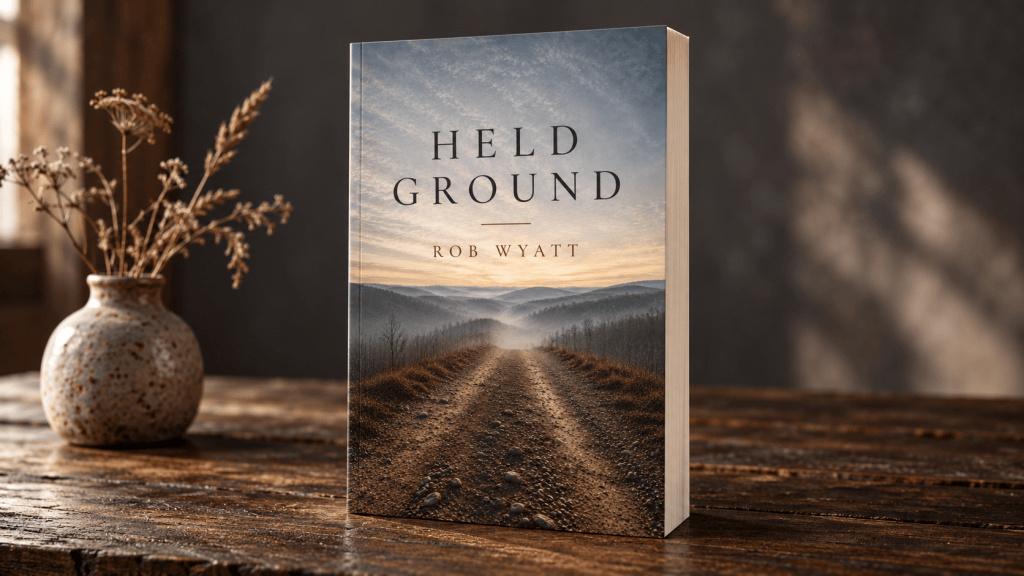
“Same Page Different Light” appears early in Held Ground, my first book. It begins with a question that runs through many of the essays: what happens to a memory when the person remembering it has changed? Here is a passage from the opening.
From “Same Page Different Light”
I used to think memory belonged to the past.
Lately, I am less sure. Memory may begin there, but it does not live there. It lives wherever I am standing now. It follows me into the present and waits to see what man is standing there to look at it.
The facts remain stubborn. The cold was cold. The hunger was hunger. The body remembers what it remembers: a smell, a sound, the angle of light, the weight of a child against the chest, the peculiar silence after danger has passed.
That is the part I did not understand when I was younger. I thought experience accumulated like evidence. You lived something, survived it or didn’t, learned from it or didn’t, and then carried it forward. Each experience became another page in the book, written once and carried forward as if its meaning had been settled.
The trouble is that memory does not behave that cleanly. It behaves more like weather. The field is not the same field in July and January. The fence line holds. The stones remain. But frost tells one truth about the place, and summer heat tells another.
The landscape keeps its landmarks, but not its lighting.
I noticed this most clearly after an ending. Not because the ending was singular. Most endings are not. They only feel that way from inside them. Pain hurt. That was no surprise. What surprised me was how grief doesn’t make things less beautiful. It changed what beauty costs.
A warm room became difficult to enter. A laugh carried a sharper edge. A memory that once offered comfort began to ache when I touched it. Nothing about the memory had altered. I had changed, and the memory met me differently.
From Held Ground, Part 1: The Ground, Chapter 5. © 2026 Rob Wyatt.
The field metaphor gives me a way to think about this without pretending I have fully figured it out. A fence line remains recognizable in winter. The stones are still where they were. Yet the place can feel damn near unfamiliar under frost or snow vs the summer haze. Returning to a memory can be like that. I recognize what happened and find that I no longer understand it in quite the same way.
Later in the essay, I write about fatherhood changing the way I remembered my own childhood. Holding my son did not alter the facts of the past. It did make the child I had been easier to see as just a child. That seems so simple written down. It is harder to understand from inside my life where I take continuity of the self I am now for granted. The same memory could hold fear, humiliation, and tenderness together depending on where I stood when I recalled it. None of them quite displaced the others.
Grief changes the lighting as well. A room that once meant ease can become difficult to remember precisely because the ease was real. I have tried to leave that warmth intact. An ending can make the past hurt without making its happiness false. There is also a limit to what any memory lets me claim. The people I write about had lives and meanings beyond my experience of them. Remembering them closely does not give me the whole truth of who they were.
About Held Ground
Held Ground is a collection of personal essays moving through childhood, military service, fatherhood, love, and loss. Its four parts are The Ground, The Body Keeps Time, The House That Became Holy, and What Remains Accountable. There are difficult memories here, and there are kitchens, laundry, shared mornings, work done by hand. The ordinary life matters throughout. Much of what I miss, and much of what I am trying to understand, happened there.
When I began these essays, I believed I was writing about grief. Over time, the question became less about how I could get back what I lost and more about what kind of life I could make with what remained. That includes looking honestly at the harm I have caused, the things I still love, and the limits of endurance itself. Near the end, the essay “What Deserves Fidelity” asks when holding ground is faithful and when it is just a refusal to let go. “Tending” follows with hands at work and a day passing. That is where the essays leave me: still paying attention, still responsible for what I do next.

